Work was already in trouble before AI arrived to “fix” it.
For years we’ve been living with an uncomfortable contradiction: infinite technology, finite humans. Faster tools, slower people. Productivity debates rage at the national level, yet in many offices the daily experience still looks like this:
- Endless meetings that don’t move the work forward.
- Evenings and weekends slowly colonised by “just one more email”.
- Tired brains asked to do their best thinking in their worst hours.
Then along came a wave of AI hype that promised to change everything overnight. But even here, the conversation has been oddly lopsided: lots of talk about tools, not nearly enough about humans. How should we design the work week itself for a world of always‑on tech and increasingly exhausted people?
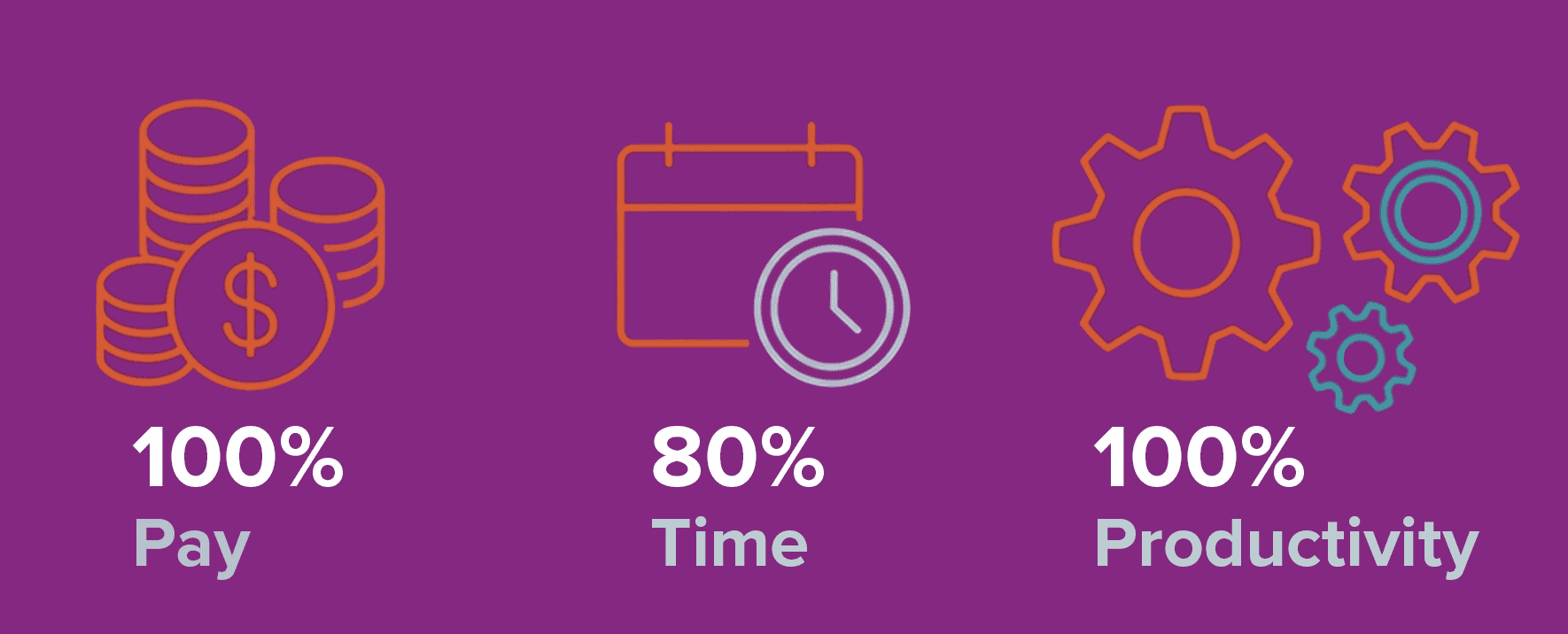
At The Walk, our answer has been to fundamentally rethink the shape of the week. Since September 2022, we have been operating a four‑day model built on a 100/80/100 promise:
And we’ve paired that with a very deliberate stance on boundaries:
- When you’re on, you’re fully focused and present.
- When you’re off, you’re genuinely off: no catch‑ups at night, no quiet creep into your non‑work day.
This is our attempt to build what we call a smarter week, one that’s better for humans and better for the work.
This article is the first in a four‑part series about what we’re learning as we go. We’ll start with the “why” and the “what” of our model, then, in later pieces, we’ll dig into how we sustain high energy, where AI fits, how we measure what matters, and what all this might mean for inequality and the future of work.
The old normal had quietly stopped working
For most of modern history, the five‑day, 40‑hour week has been treated as an unshakeable default.
It’s so familiar we forget how arbitrary it is. It’s a century‑old compromise from a very different economy. Since then:
- Technology has transformed what we can do in a day.
- The line between “at work” and “at home” has been blurred by laptops and phones.
- Knowledge and creative work have become central to growth, but our systems are still better at counting hours than at nurturing ideas.
“
The old model quietly assumed people could run at full speed, five days a week, forever. But we could see that just wasn’t true. Our four‑day week is about building a way of working people can sustain for a career, not just a quarter.
”
Nick Cantor, Co-founder of The Walk Agency
People feel it in their bodies as much as in their calendars. Burnout, stress and disengagement have become chronic issues. Many organisations have tried to solve this with flexibility: work from home, staggered start times, email charters, wellness programs.
These have all helped a bit. But in practice, a lot of “flexibility” has come to mean something else:
- Start later to do life admin, then quietly log on again at 9:30 pm.
- Slip out for an appointment, then “make it up” on your day off.
- Be free to work anywhere, but never really stop working.
When Australia debated the right to disconnect, we recognised a shared unease with this blur. Being theoretically allowed to turn your phone off is not the same as having a work design that doesn’t quietly demand that you stay on.
We felt that tension too.
Our decision: a 4‑day week with clear boundaries
As a creative and strategic agency, The Walk sells thinking, creativity and execution. Our product is not hours; it’s outcomes.
We had been following the global 4 day week movement and the growing evidence that shorter weeks can increase productivity, not just morale. We were also in the middle of our own internal questions about sustainability:
- How do we keep talented people for the long term, not just until burnout?
- How do we create space for health, connection and purpose without quietly stealing it back via late‑night work?
- How do we respond to AI and automation in a way that actually improves lives, not just margins?
That’s what led us, back in September 2022, to a simple but radical decision: redesign the week itself.
The model we chose has three defining features:
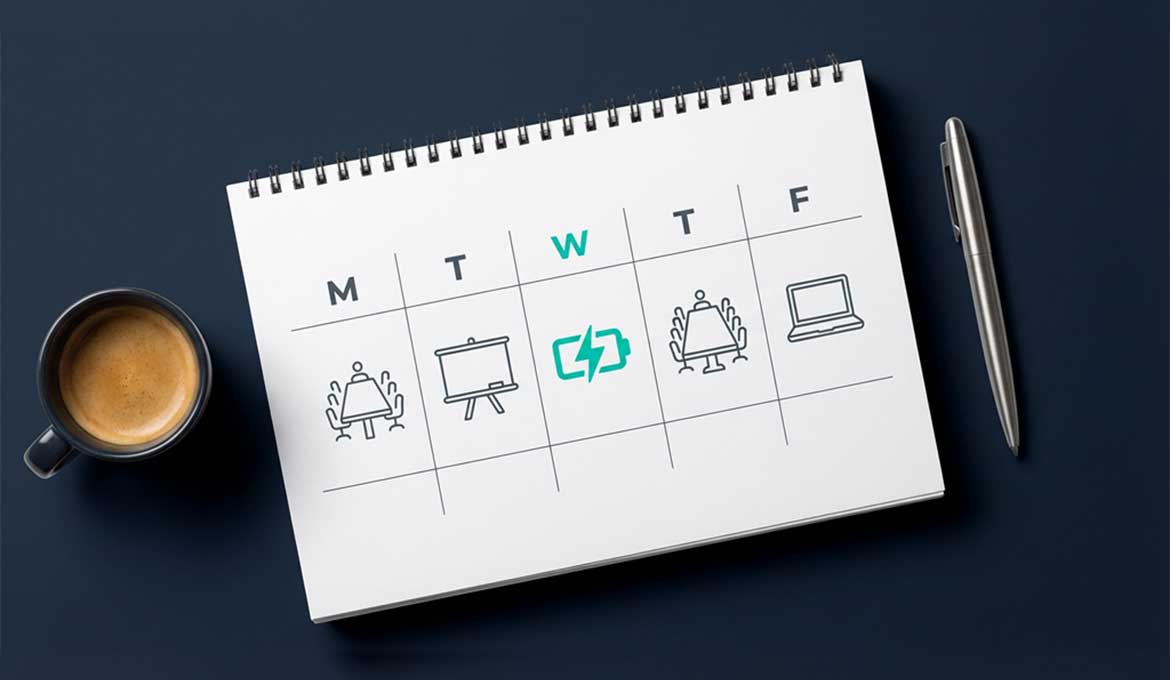
- A 4‑day week: one standard, recurring non‑work day every week.
- 100/80/100: full pay, 80% time, with a commitment to maintaining or improving productivity.
- Binary boundaries:
- Work days are work days. You’re on. You go.
- Non‑work days are non‑work days. You’re off. Go enjoy life, find health, connection, purpose.
In other words, we didn’t just cut a day and hope for the best. We paired the shorter week with much sharper edges around work time and non‑work time.

This is not the version of flexibility where you leave early, then open the laptop again at night. It’s the version where you work hard while you’re on, then genuinely stop.
What 100/80/100 actually means
100/80/100 sounds simple. Living it is anything but.
The promise is:
- 100% pay: nobody takes a financial hit.
- 80% of the time: we operate on four standard days.
- 100% of the output: clients should see the same or better results.
A 4‑day week can’t just be “less work”. In a service business like ours, that would quickly show up as missed deadlines, lower quality or stressed staff quietly working on their “day off” to keep up.
So something has to change. Broadly, there are only three options:
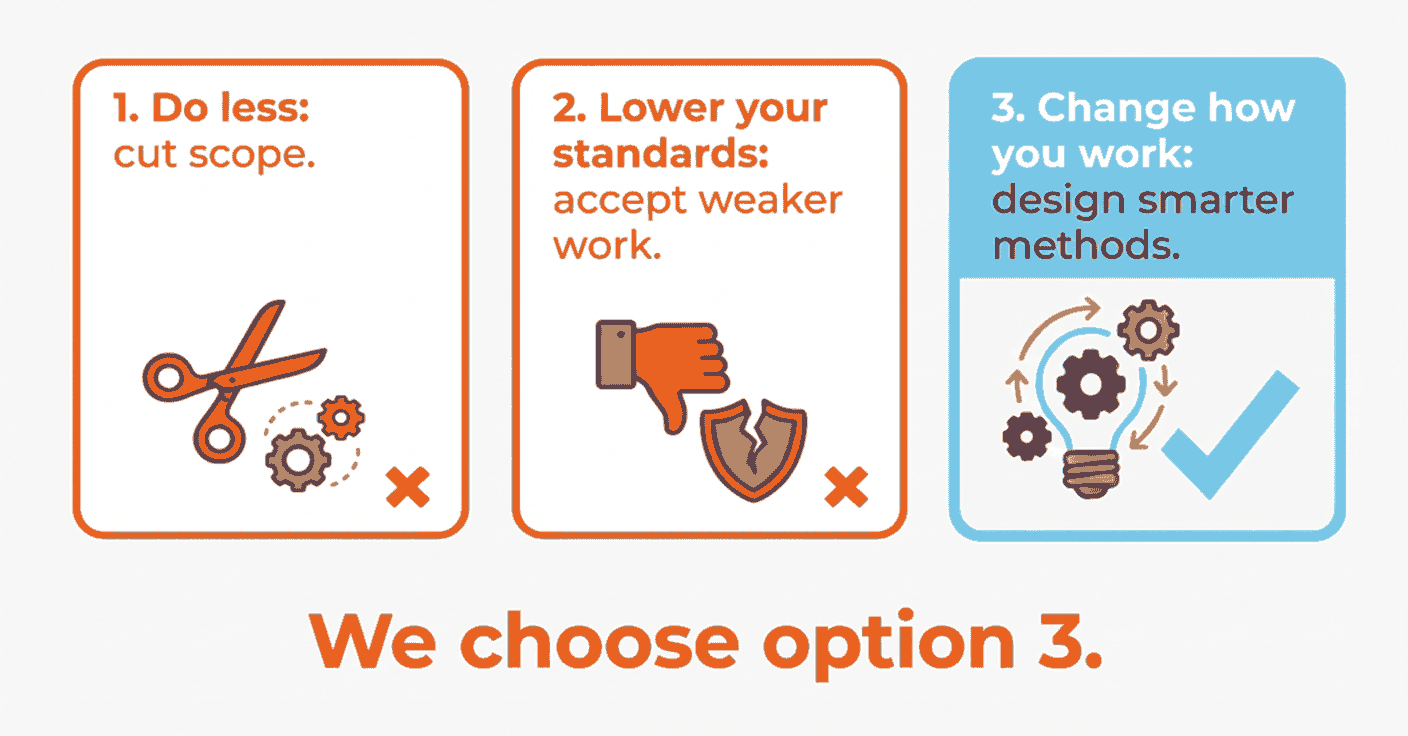
That decision has driven a whole series of shifts:
- Fewer, better meetings
Meetings now need a clear purpose and outcome. We’ve shortened many, killed some, and made a lot of them smaller. If a meeting doesn’t move the work forward, it doesn’t survive in a 4‑day world. - Sharper prioritisation
With one less day, “nice to have” work suddenly becomes very visible. We’re much more explicit about what must be achieved each week, and what gets parked. - Better use of tools and systems
We’ve doubled down on project management, standardised briefs and templates to avoid reinventing the wheel, and adopted a more rigorous approach to focus and deep work. (More on this in future pieces.) - Candid conversations with clients
We’ve been transparent about our model and clear about response times and availability. So far, clients are less interested in the days we sit at desks than in the quality and reliability of what they receive. When the work gets better, so do those conversations.
None of this is magic. It’s a lot of small, intentional design decisions that add up to a different week.
How we changed what we measure
Changing the shape of the week forced us to change how we think about performance.
If you remove a day but keep measuring success in terms of time spent, everyone loses. To make 4DW and 100/80/100 real, we had to get clearer about what really matters and who owns it.
Every person at The Walk has their own objectives and key results (OKRs). These are not abstract corporate slogans. They translate directly into:
- The outcomes they are accountable for.
- The value they are expected to create.
- How they show that they are contributing to 100% productivity.
Instead of asking, “have you worked enough hours?”, we ask, “how are you tracking against your OKRs, and how does that relate to our 100% productivity goal?”.
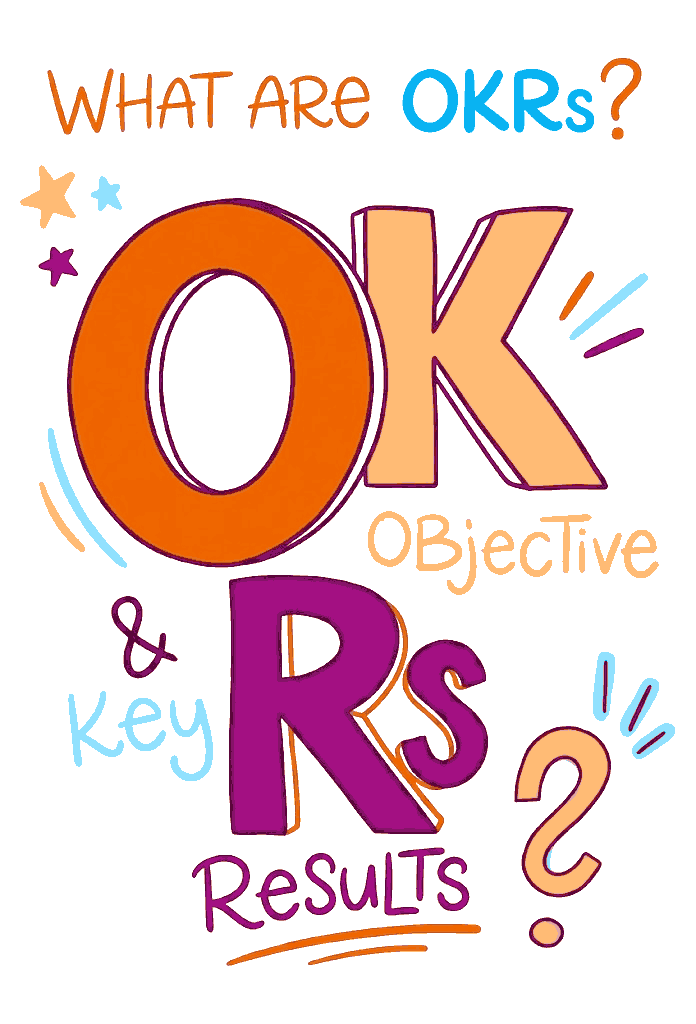
That shift has some important effects:
- More ownership
People are responsible for showing how well they are delivering on their OKRs. It is not something done to them once a year; it is part of the rhythm of work. - Clearer conversations
When something is off track, we have a concrete frame for discussion: is it the OKR, the resourcing, the process, or the support that needs to change? - A better link between individual effort and agency‑wide 100/80/100
Everyone can see how their results roll up into our ability to sustain the model. Productivity stops being an abstract management word and becomes a shared, visible goal.
“On” means on. “Off” means off.
The distinctive part of our model isn’t the number of days. It’s the binary approach to time.
We’ve all seen how “flexible” work can become a kind of time‑debt: stepping away in the afternoon, then paying it back late at night. Over the course of a week, you end up working the same or more hours, just in a messier pattern.
We wanted the opposite: simplicity and certainty.
So we’ve become very clear, as a company, about what’s expected:
- On your work days, we want your full focus within agreed hours.
- On your non‑work day (and outside working hours), we do not expect you to be available.
This is backed up by how we behave:
- Leaders don’t send late‑night emails expecting replies.
- We don’t quietly celebrate people who break the boundary as “heroes”.
- If something is genuinely urgent, we treat it as an exception, not a new normal, and we examine why it happened.
The result is that people can actually relax when they’re off. They can invest that time in health, family, hobbies, rest, community, or whatever gives their life meaning, without a nagging sense that they “should probably check in”.
That’s part of what makes the “on” time more powerful. Knowing there’s protected space on the other side changes how people show up. There’s more energy and focus, and more willingness to push for clarity and decisions, because they’re not pacing themselves for a seven‑day marathon.
What we’re seeing so far
We have been on this path since September 2022, and we’re still learning. But some patterns are clear.
1. More energy and better thinking
The most immediate shift has been in how people feel.
- Mondays are sharper. People turn up rested, not recovering from a weekend of catch‑up, and it shows in the first stand‑up.
- There’s less of the “Friday fade” where tired hours produce little value.
- Strategy and creative sessions have more in the tank: fewer glazed eyes, more genuine contributions.
In a business where we’re paid to think clearly and creatively, that matters.
2. Better conversations about value
Moving away from “time equals value” has forced us to get more honest about what clients are really buying.
They’re not buying our presence in a chair from 8:30 to 5. They’re buying insight, ideas, execution and results, all delivered predictably and to a high standard.
A 4‑day week has been a useful lens for re‑examining how we scope, price and talk about our work. It has nudged us further along the path from selling time to selling value.
3. Stronger culture around boundaries
Shortening the week has made some conversations easier.
- It’s clearer when we’re asking too much of people.
- It’s more obvious when a process is broken and eating time.
- It’s easier to spot creeping expectations that would drag us back into “always on” mode.
Because we’ve collectively committed to 100/80/100, there’s permission to question work that doesn’t clearly support that goal. The norm is no longer “just fit it in somehow”; the norm is “how do we redesign this so it fits?”.
It’s not easy, but it is worth it
It would be dishonest to pretend any of this is frictionless.
We’ve had to unlearn habits built over entire careers:
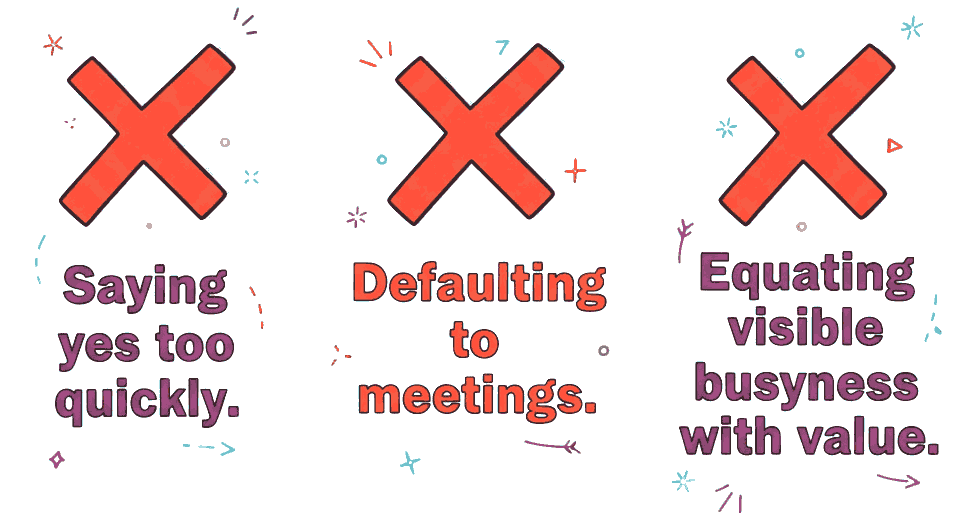
We’ve had to test and adjust our internal systems, and we’ll keep doing that. We’ve had moments where old patterns sneak back in and we have to notice and correct them.
We’ve also had to be honest that a 4‑day week won’t automatically suit every individual or every role in exactly the same way. There are nuances we’re still working through.
But the direction of travel feels right.
If the last decade has taught us anything, it’s that simply adding more tools and more flexibility on top of the same old work week won’t fix what’s broken. At some point, you have to touch the structure itself.
This is just the start
This article has focused on the basic shape of our model and why we chose it. There are a few big themes we’ve only hinted at so far, which we’ll explore in the rest of this series:
- How we sustain a high‑energy, innovative team in a 4‑day world
The practices, rituals and mindsets that help people bring more enthusiasm and creativity to the four days they work, and how we protect their three days off. - Where AI fits, and who benefits from it
How we’re using AI to change methods rather than just making people work faster, and how 4‑day weeks could become a way to share the productivity gains more fairly rather than letting them pool in fewer hands. - How we keep score
How OKRs, individual ownership and transparent measures of productivity help us keep 100/80/100 real, not just rhetorical.
Work was always going to have to evolve. AI has only made that more urgent. At The Walk, our bet is that the organisations who will thrive are those who design a smarter week, one that respects human boundaries, leverages technology wisely, measures what matters, and treats time as a precious, non‑renewable resource.
We don’t claim to have all the answers. But we do know this:
When you’re on, you should be able to go all in. And when you’re off, you should be able to go and live.
Like what we’re on about? Subscribe to our perspectives series and you’ll receive updates straight to your inbox once a quarter.